
How to Interview Your Customers Before You Have Any
Customer interviews are the best validation tool you have, but early on you don't have customers. Here's how to run the conversation anyway.
By James Edgewood · Contributor at TheQuandary
Every founder hears the same advice: talk to your customers. It's good advice. It also runs into a wall early on, because the moment you most need to hear from customers, before you've built anything, is the moment you have none.
So this post is about two things. How to run a customer interview that actually teaches you something, and what to do when you can't find anyone to interview yet.
Why interviews beat surveys
A survey tells you what people think they'd do. A good interview tells you what they've actually done. That gap matters, because people are bad at predicting their own behavior and reasonably good at describing their past.
Most of the discipline comes down to one idea from The Mom Test: ask questions people can't easily flatter you on. In practice that means:
- Ask about the last time it happened, not whether they'd use your thing.
- Ask what it cost them in time or money.
- Then stop talking and listen. You're there to learn, not to pitch.
Questions that get real answers
Good questions dig into behavior and workarounds, not opinions:
- Walk me through the last time you ran into this. A story beats an opinion.
- What did you do about it? This is where the real competitor turns up, usually a spreadsheet.
- What was annoying about that?
- How much time or money did it cost you?
- What would have to be true for you to switch?
None of these mention your idea. In the best interviews, it barely comes up.
The cold-start problem
Here's the part nobody likes to admit. When your idea is brand new, you can't get 20 ideal customers on the phone. Cold outreach mostly gets ignored, your own network isn't your target market, and the people who will happily talk to you usually aren't the ones who'd buy.
So a lot of founders skip it and start building blind. It's understandable, and it's a mistake.
Rehearse the interview first
This is the specific gap TheQuandary was built for. Instead of waiting weeks to find real people, you describe the idea and it generates customer archetypes: specific personas with goals, budgets, and their own skepticism, who react the way real customers would.
Then it goes a step further. After the run, the personas stick around and you can interview them. Ask why they pushed back. Ask what would change their mind. Ask who they'd tell about it. They answer in character, drawing on their profile and what they said during the simulation.
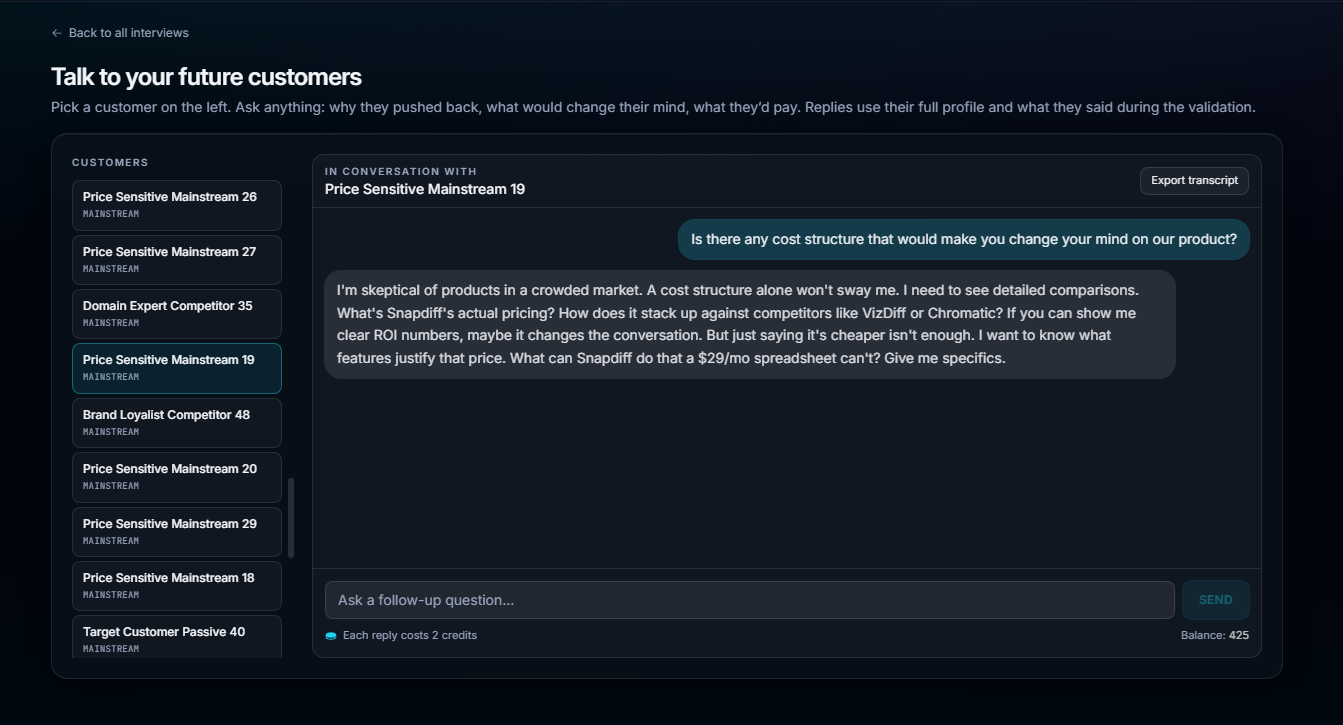
Following up with one persona about its objections after a run. Each persona keeps the profile and opinions it formed during the simulation, so the answers stay consistent.
Why this helps: it doesn't replace real conversations, it sharpens them. You go into your first real interviews already knowing the likely objections, instead of spending those conversations working out what to ask.
The objections are also tied to real public quotes, actual posts from Reddit, Hacker News, and forums where these people already complain. So you're not just reading a model's guess. You're seeing patterns from real voices, with links you can open and check.
Interview your future customers today. Run a simulation, then talk to the personas afterward. Export the transcript and reuse the answers in your pitch and your landing copy. → Validate my idea
Take it into the real world
Whatever comes out of a rehearsed interview, the objections, the exact words people use, the features they don't care about, is raw material. Put the phrases people actually used into your landing page. Lead your real interviews with the questions that got the strongest reactions. Drop your toughest skeptic persona into a pitch rehearsal and see how it holds up.
None of this replaces talking to real customers. The point is that when you finally get those 30 minutes with a real buyer, you don't waste them learning something you could have learned for free.
Next steps
- If you're new to this, start with the full framework for validating an idea.
- No idea yet? Here's how to find one from the skills on your résumé.
Common questions
How many customer interviews do I need?
There's no magic number, but 10 to 20 conversations with your target customer usually surface the main objections and patterns. You'll often hear the same things by the seventh or eighth interview, and that repetition is the signal you're looking for.
What questions should I ask in a customer interview?
Ask about the past, not the future. 'Walk me through the last time you hit this problem', 'What did you do about it', and 'What did that cost you' tell you far more than 'Would you use this'. Hold off on pitching your idea until the very end, if at all.
What if I can't find any customers to interview?
Early on that's normal. Read where your customers already complain, like Reddit, niche forums, and competitor reviews, for unfiltered objections. You can also rehearse with simulated customer interviews so your first real conversations aren't spent figuring out what to ask.
Are customer interviews better than surveys?
For early validation, yes. Surveys capture what people say they would do, while interviews let you dig into what they've actually done, which is a much more reliable predictor of real behavior.
Stop guessing whether anyone wants it.
Run AI-simulated customer reactions and walk away with archetypes, objections, and a confidence score — in minutes, not months.
200 free credits on signup. No card required.