
How to Validate a Business Idea Before You Build It
A practical, step-by-step way to test whether anyone actually wants your idea before you spend months building it.
By James Edgewood · Contributor at TheQuandary
Most startups don't fail because the product was bad. They fail because not enough people wanted it. That's the expensive version of the mistake: you spend months building something, launch it, and find out the demand was never really there.
The good news is you can usually find that out earlier, and for a lot less. That's what validation is for. Here's how I'd go about it.
What validation actually means
Validation isn't your friends telling you the idea sounds cool. It's gathering enough evidence that a specific group of people has a problem they care about, and that they'd pay someone to solve it.
In practice I'm looking for three things:
- The problem comes up often enough that people are genuinely annoyed by it.
- They're already doing something about it. A spreadsheet, a manual process, a competitor they tolerate. A workaround is proof the demand exists.
- They'll actually pay. Interest is easy to get. A credit card is the real signal.
If you can't point to evidence for those, what you've got is a hypothesis. That's fine, as long as you don't mistake it for a validated idea.
Interest is easy to get. A credit card is the real signal.
Start with your riskiest assumption
Every idea is a stack of assumptions, and one of them is load-bearing. Usually it's some version of "people with this problem will pay for this solution." Pricing, channels, and features don't matter until that one holds up.
A quick way to sort it: if your riskiest assumption is about whether people want it, go test demand. If it's about whether you can build it, prototype. Most founders reach for the prototype, because building feels like progress. That's exactly why validation gets skipped.
Common mistake
Building because it feels like progress. A prototype answers "can I make this?" — but the question that kills most startups is "does anyone want it?" Those are different assumptions. Test the load-bearing one first.
Get specific about who it's for
"Small business owners" isn't a customer. "Solo Shopify owners doing $5–20k a month who pack their own orders" is. The narrower you go, the easier everything downstream gets. You can find these people, guess their objections, and write copy that sounds like you've actually met them.
It helps to write out one concrete person: their goals, what frustrates them, what they can spend. Then argue with that person in your head instead of with an abstract market. TheQuandary can generate these personas and let you talk to them, but a sticky note works too.
Write down the objections before you hear them
You already know the reasons people will say no. Write them down honestly. The usual ones:
- It's a nice-to-have, not something I need.
- I already do this with a spreadsheet or a free tool.
- I don't trust a new company with this yet.
For each, decide whether it's a dealbreaker or just a messaging problem. Dealbreakers can sink the idea. Messaging problems you can fix. Being honest at this stage is uncomfortable, and it saves you months.
Read what your customers already say
Before you talk to anyone, read. Your customers are already complaining in public, for free.
- Search Reddit, Hacker News, and niche forums for the problem in their own words.
- Read the one-star reviews of competitors. That's a list of unmet needs.
- Notice which questions come up over and over. Repetition is a kind of demand.
The point is to ground the idea in what real people say, not in how you feel about it on a good day. When the same objection shows up across a dozen threads, take it seriously.
Talk to customers, or rehearse it first
The standard advice is to interview 10 to 20 potential customers, and it's right. The trick is to ask about what they've done, not what they'd do. "Have you ever paid to solve this?" tells you far more than "Would you pay for this?" The Mom Test covers this well; there's more on running these conversations.
The honest problem is that early on you usually can't line up 20 ideal customers willing to give you half an hour. That's the gap TheQuandary fills. It runs simulated customer reactions, so you can hear the objections and the shrugs before you've found anyone to talk to, then walk into the real conversations already knowing what to dig into. (If you want the AI-specific version of this, see how to validate a business idea with AI.)
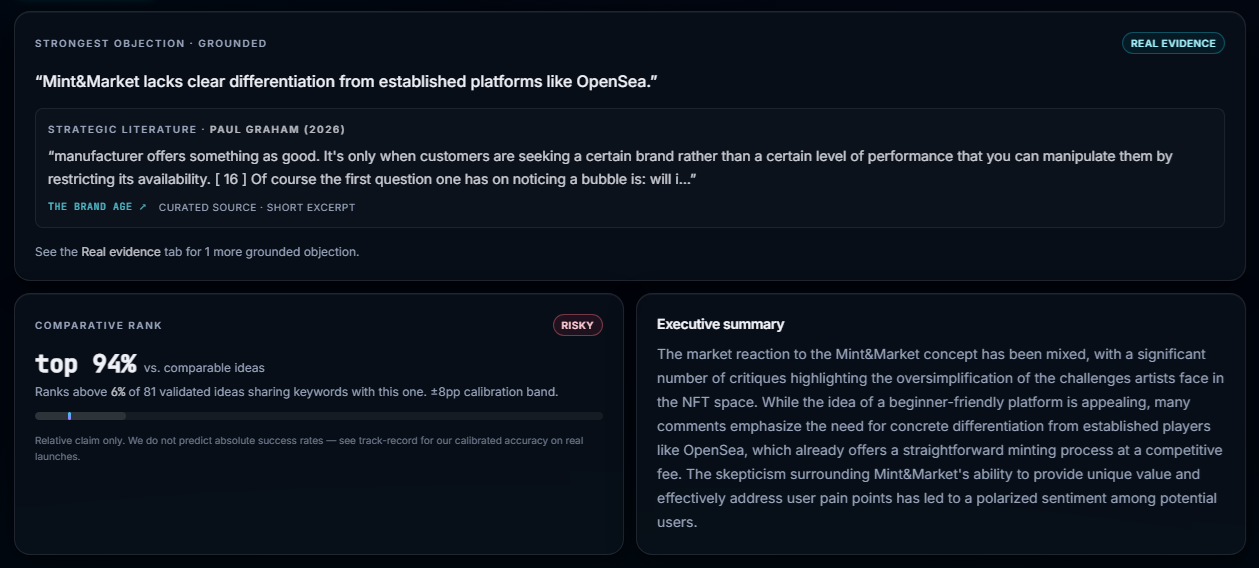 What a validation run hands back: ranked objections and a confidence score you can defend.
Hear the objections before you build. A simulation gives you customer archetypes, the objections ranked and tied back to real public quotes, and a confidence score you can defend. → Find me an idea
End with a decision
Validation should end in a decision: go, no-go, or change something. Give yourself a confidence read you'd be willing to explain out loud to a co-founder, not a number you picked to feel better. If the signal is weak, that's not a failure. It's a few months you just got back.
Ways people fake it
A few traps worth naming, because they produce confidence without any real evidence:
- Leading the witness. Ask "wouldn't this be useful?" and you'll get a yes that means nothing.
- Counting compliments. "I'd totally use that" is the most expensive sentence in startups.
- Treating traffic as demand. Clicks are curiosity. Payment is demand.
- Validating the solution instead of the problem. People can love how you framed the problem and still not want your version of the fix.
Where to go next
Validation is cheap insurance. A week of honest testing buys back months of building the wrong thing. Work out your riskiest assumption, get specific about the customer, write down the objections, ground them in real voices, and force a decision at the end.
And if you don't have an idea to validate yet, that's solvable too. You can start from your own skills and work backward to a few worth testing.
Common questions
How do I validate a business idea with no money?
Start with the free signals before you spend anything. Read how people describe the problem in public forums and competitor reviews, then run a handful of behavioral interviews. If you can't line up interviews yet, simulated customer reactions can stand in. You only need to spend money once you've seen real demand worth testing further.
How long does it take to validate an idea?
A focused first pass takes a few days to two weeks, not months. The goal isn't certainty, it's gathering enough evidence to make a confident go, no-go, or pivot decision before you start building.
How do I know when my idea is validated?
When you can point to evidence that a specific group has the problem often, is already paying for or working around it, and would switch to your solution. Compliments and traffic don't count. Payment and existing workarounds do.
Should I validate the problem or the solution first?
The problem. People can love how you frame a problem and still reject your specific solution, so confirm the problem is real and painful before you test whether your fix is the one they'll pay for.
Stop guessing whether anyone wants it.
Run AI-simulated customer reactions and walk away with archetypes, objections, and a confidence score — in minutes, not months.
200 free credits on signup. No card required.