
How to Find a Business Idea From the Skills on Your Résumé
You don't need a flash of genius to start a company. The best ideas usually come from skills you already have. Here's how to find them in your own experience.
By James Edgewood · Contributor at TheQuandary
A lot of people want to start something but feel stuck at the very beginning, because they don't have an idea. The usual advice, follow your passion or find a huge market, doesn't help much. It treats ideas like they arrive in a flash of inspiration.
They usually don't. Most solid startup ideas come out of something you already have: skills you've built, an industry you know, and a close-up view of what's broken in it. Your résumé is a good place to start looking.
Why your own experience is a good starting point
Ideas that come out of your own work have a few advantages that passion projects often don't:
- You've seen problems from the inside that outsiders don't even know exist.
- You can actually build or sell the thing, because it sits next to what you already do.
- Customers tend to trust someone who clearly knows their world.
Someone who spent five years in logistics will notice a workflow gap that would take an outsider years to even see. That gap is a candidate idea.
Step 1: List what you actually know
Go through your work history and write down, honestly:
- Hard skills. Things you can do that most people can't: writing SQL, running paid ads, negotiating contracts, designing a clinical workflow.
- Domain knowledge. Industries, tools, and processes you understand well.
- Recurring pain. What you and your coworkers complained about constantly, and what was held together with spreadsheets and duct tape.
That last one is where the ideas hide. Every recurring complaint from a job you've held is a candidate problem, and you already know it's real because you lived it.
Step 2: Turn the pain into candidates
For each problem, ask a simple question: could a product fix this, and would someone pay for it? You'll end up with a messy list, which is the point. Aim for quantity first and save the judgment for later. Five or ten rough candidates, each tied to a real problem you've seen, is plenty.
Don't kill ideas too early. It's easy to talk yourself out of something because you can picture one objection. The better move is to test it cheaply rather than reject it in your head. An idea that feels weak can do surprisingly well once real customers react to it.
Step 3: Let something rank them for you
Doing all of this by hand is slow, and it's hard to be objective about your own ideas. This is what TheQuandary's Reverse Mode is for.
Instead of starting with an idea, you start with yourself: your skills, your budget, your interests, and the things you'd refuse to build. From that it generates five candidate businesses, runs a quick validation on each against simulated customers, and ranks them.
You can feed in your résumé directly. It pulls out the skills and uses them to shape the candidates, without keeping the file. What you get back isn't a brainstorm dump, it's a shortlist with a read on each one:
| Candidate idea | Read |
|---|---|
| Async stand-up tool for distributed eng teams | Strong |
| Compliance checklist generator for early SaaS | Promising |
| Internal API documentation auto-updater | Worth testing |
| AI changelog writer for B2B products | Crowded |
Pick the one that looks best, promote it to a full validation, and start from something concrete instead of a blank page.
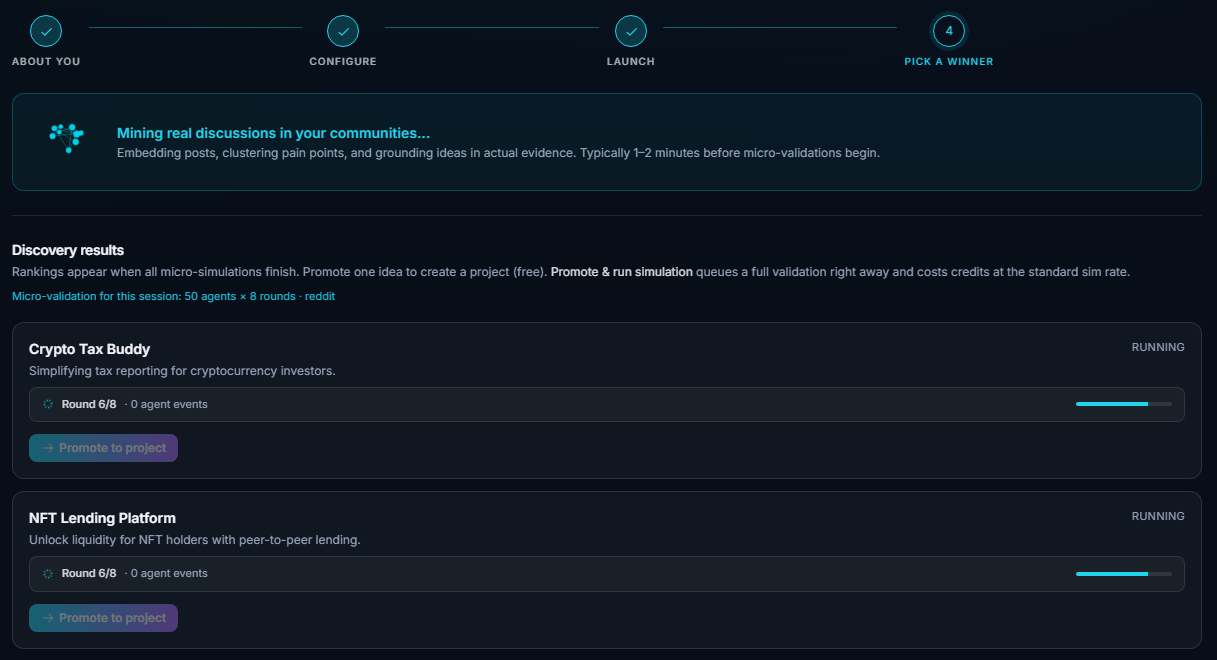 Reverse Mode turns your skills into candidate businesses, validated and ranked.
Don't have an idea? We'll find one. Tell us your skills, budget, and interests, and Reverse Mode generates candidates, validates each, and ranks them. → Find me an idea
Step 4: Validate the one you pick
A ranked shortlist tells you where to point your attention. It doesn't finish the job. Once you've picked the most promising candidate, run it through real validation: map the objections, ground them in real customer voices, and get to a clear go or no-go.
That's the same process in how to validate a business idea, and once you've got something worth testing, interviewing your future customers is the natural next step.
The takeaway
You're probably not out of ideas. You're sitting on years of domain knowledge and a list of problems you already know are real. Go through your résumé, turn the pain into candidates, and let something rank them. The idea that fits you best is often one you're unusually well placed to see.
For the bigger picture on using AI across the whole journey, from idea to launch, see how to start a business with AI.
Common questions
How do I come up with a business idea?
Start from what you already know. List your hard skills, the industries you understand, and the problems you and your coworkers complained about most. Recurring pain in a job you've held is a candidate idea you already know is real.
What business should I start with my skills?
Usually the best one solves a problem you can see clearly because of your experience, and that people already pay to work around. Generate several candidates instead of betting on your favorite, then test them cheaply against real customer reactions.
Can I use my résumé to find a startup idea?
Yes. Your work history is a list of skills and problems you've seen firsthand. TheQuandary's Reverse Mode can take your skills, budget, and interests and generate ranked candidate businesses, each validated against simulated customers.
Do I need an original idea to start a business?
No. Most successful businesses aren't novel, they solve a known problem better for a specific group. An idea grounded in your own expertise and a real, existing pain beats a clever idea nobody wants.
Stop guessing whether anyone wants it.
Run AI-simulated customer reactions and walk away with archetypes, objections, and a confidence score — in minutes, not months.
200 free credits on signup. No card required.