
AI Business Ideas: How to Find One That Actually Fits You
Generic AI business idea lists are a dime a dozen. Here's how to use AI to find an idea that fits your skills, your budget, and a real problem worth solving.
By James Edgewood · Contributor at TheQuandary
Search for "AI business ideas" and you'll get the same lists everyone else gets: AI chatbots, AI content tools, AI for real estate. The problem isn't that these are bad. It's that they're public, which means they're crowded, and a list can't tell you which one fits your skills or whether anyone will pay.
There are really two questions hiding under "AI business ideas," and it's worth separating them. One is what business can I build that uses AI? The other is how do I use AI to find a business idea at all? This post covers both, and how to land on one that actually fits you.
Why generic AI idea lists don't work
A list of ideas anyone can read is, by definition, a list anyone can act on. The ideas that work tend to come from something specific to you: a niche you understand, a workflow you've watched waste people's time, a problem you've personally hit. AI is good at generating options, but if you give it nothing about yourself, it gives back the average of the internet, which is exactly where the competition already is.
So the move isn't to find a better list. It's to generate ideas grounded in your own situation. There's a fuller walkthrough of mining your own background in finding a business idea from your résumé.
AI-native ideas worth a look (and the catch)
If you want a business built on AI, the categories that tend to hold up share one trait: they pair AI with something defensible.
- Vertical tools for a specific industry. A general AI assistant is a commodity. An AI tool that knows the quirks of, say, dental billing or freight brokerage is not, because the knowledge is the moat.
- AI-assisted services. Productized services where AI does the heavy lifting and you provide judgment and accountability. Lower tech risk, real margins.
- Automating a narrow, painful workflow you understand from the inside.
The catch with all of these: the AI is rarely the moat. The model you're using is available to everyone. What's defensible is your domain knowledge, your data, and your ability to reach customers. Plan the business around those, not around having access to a model.
How to actually find one
The reliable process is the same one that works without AI, just faster:
- Give the AI your context. Your skills, budget, what you'd refuse to build, the industries you know. Ask it for problems worth solving, not finished products.
- Generate a lot, then cut. Aim for quantity first. Most will be weak; you're mining for the two or three that only you could credibly pursue.
- Validate before you commit. A clever idea nobody wants is worse than a boring one people will pay for. Test the best candidates against real customer reactions, covered in how to validate a business idea with AI.
This is what TheQuandary's Reverse Mode automates: you describe yourself, it generates candidate businesses, runs a quick validation on each, and ranks them, so you skip the generic list entirely.
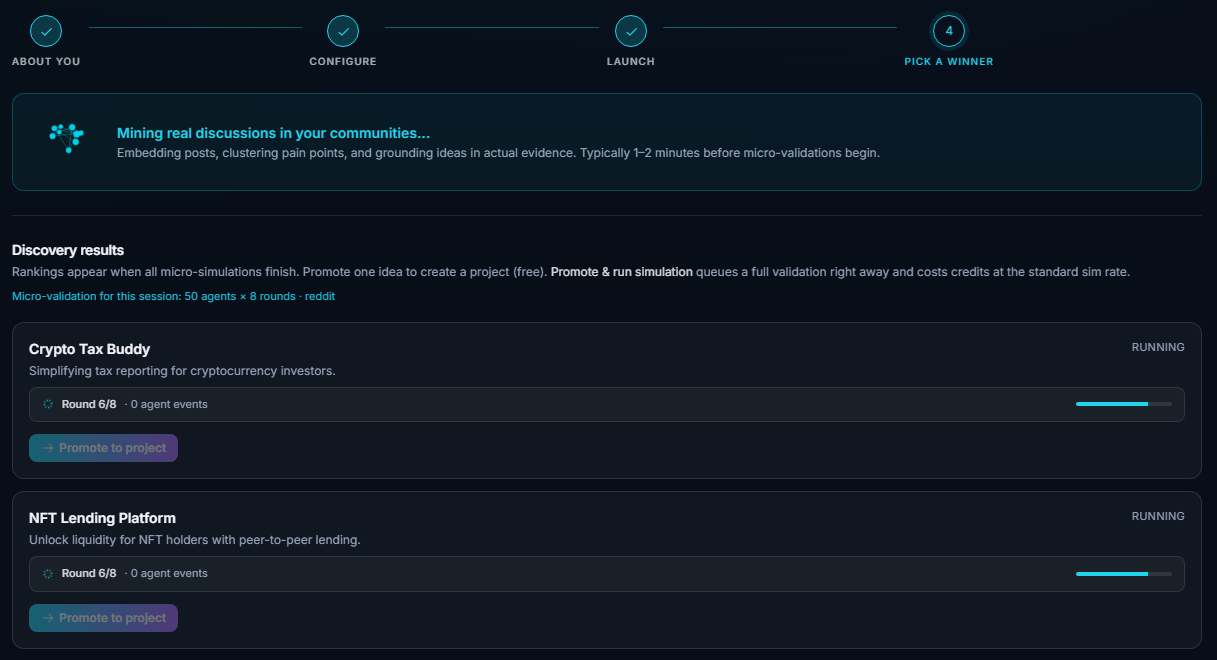 Reverse Mode turns your skills into candidate businesses, validated and ranked.
Don't have an idea yet? We'll find one. Describe your skills, budget, and interests, and Reverse Mode generates candidates, validates each, and ranks them by how well they hold up in simulation. → Find me an idea
The takeaway
A good AI business idea isn't something you find on a list. It's the overlap between a real problem, a group that'll pay to solve it, and an unfair advantage you happen to have. Use AI to generate candidates fast and to test them cheaply, then back the one with the strongest signal.
For the bigger picture, see how to start a business with AI, and if you're wondering how much of the ideation AI can really do, can AI come up with a business idea? goes deeper.
Common questions
What are some good AI business ideas?
The good ones usually aren't on a generic list, because anything on a public list is already crowded. The better question is what problem you can see clearly because of your background that AI could now solve cheaply. Vertical tools for a specific industry, AI-assisted services, and automating a narrow workflow you understand tend to beat broad 'AI for everyone' ideas.
How do I find a business idea with AI?
Feed the AI your context: your skills, budget, industry, and the problems you've watched go unsolved. Ask it for problems worth solving, not finished products. Generate a lot of candidates, then validate the best few against real customer reactions before committing.
Are AI business ideas saturated?
The obvious ones are. 'An AI chatbot for X' is crowded almost everywhere. What's not saturated is deep, specific knowledge of a niche combined with AI to solve a real pain there. The moat is usually your domain insight and distribution, not the AI itself.
Can I start an AI business without technical skills?
Yes. Many AI businesses are services or thin tools built on existing models with no-code platforms. Domain expertise and the ability to find customers matter more than being able to train a model. You can always partner for the technical depth later.
Stop guessing whether anyone wants it.
Run AI-simulated customer reactions and walk away with archetypes, objections, and a confidence score — in minutes, not months.
200 free credits on signup. No card required.