
How to Use AI to Validate a Business Idea
AI can't tell you if your idea will work, but it can give you a fast, cheap first read on demand and objections before you build. Here's how to do it well.
By James Edgewood · Contributor at TheQuandary
"Will anyone want this?" is the question every founder needs answered before they build, and the one that's hardest to answer early. Real customers are slow to find and slower to interview. AI doesn't remove that problem entirely, but it gives you a fast, cheap first read, so you go into the expensive work already knowing where the idea is weak.
What follows is how to do that well, and where the line is: what AI validation can actually tell you, where it falls down, and the steps to run a useful one. The point isn't the technology. It's getting an honest read on demand sooner than you otherwise could.
What AI validation can and can't do
Be clear about this up front, because most disappointment comes from expecting the wrong thing.
What it can do: generate realistic customer reactions, surface the objections you'll hear, point at who's most likely to buy first, and let you test variations quickly. It compresses days of guesswork into minutes.
What it can't do: prove demand. No simulation can replace a real customer handing over money. AI gives you a prediction grounded in patterns, not a verdict. The right way to use it is to find problems early and decide where to spend your limited time, then confirm the big findings with real people.
Why it beats a survey (and waiting)
The old options for early validation are surveys and interviews. Surveys mostly capture what people say they'd do, which is a notoriously bad predictor of what they actually do. Interviews are far better, but early on you can't find 20 ideal customers willing to talk, so founders skip validation and build blind.
AI sits in the gap. It's faster than recruiting interviewees and more revealing than a survey, because you can ask follow-up questions and re-run the whole thing as you change the idea. It's not a replacement for the real conversations covered in the manual validation framework, it's the cheap first pass that makes those conversations sharper.
How to validate an idea with AI, step by step
1. Describe the idea and the customer specifically
Vague inputs give vague results. "An app for small businesses" tells the model nothing. "A tool for solo Shopify owners doing $5–20k a month who pack their own orders" gives it a real person to react as. The narrower your target, the more useful the objections.
2. Simulate the reactions
Run the simulation and read how those customers respond. You're looking for the shape of the response: enthusiasm, indifference, or specific pushback. With TheQuandary, this produces customer archetypes and a confidence read rather than a single yes or no.
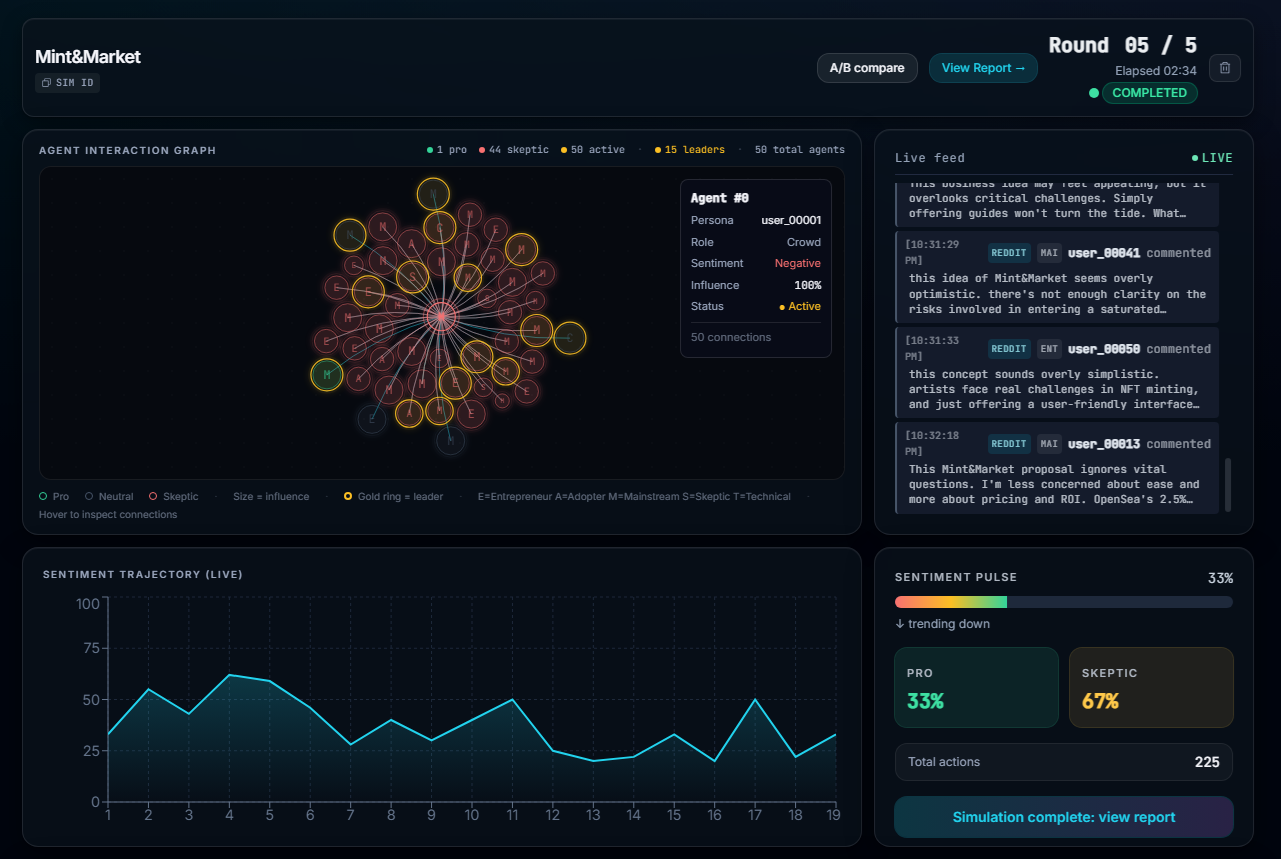 Simulated customers reacting to the idea in real time.
3. Read the objections, grounded in real voices
The objections are the gold. They tell you what you'll have to overcome. The ones worth trusting are tied to evidence, real public posts where people already complain about the problem, not invented. TheQuandary matches objections back to actual quotes from places like Reddit and Hacker News, with links so you can judge the relevance yourself.
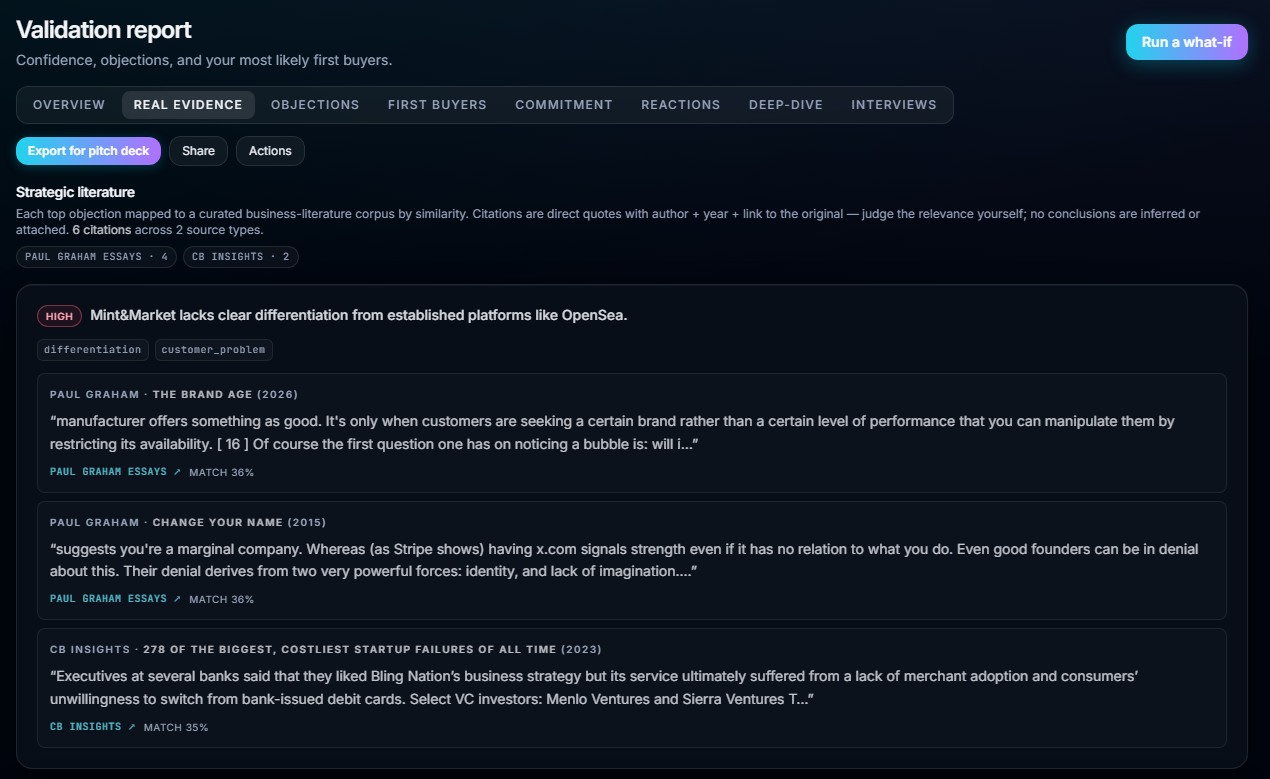 Objections matched back to real public quotes, with links to the source.
4. Interview the personas
A static report only gets you so far. The useful part is being able to ask why. After a run, you can interview the personas directly: why they pushed back, what would change their mind, what they'd pay. Treat it as a rehearsal for the real customer interviews you'll do later; there's more on those in interviewing your customers before you have any.
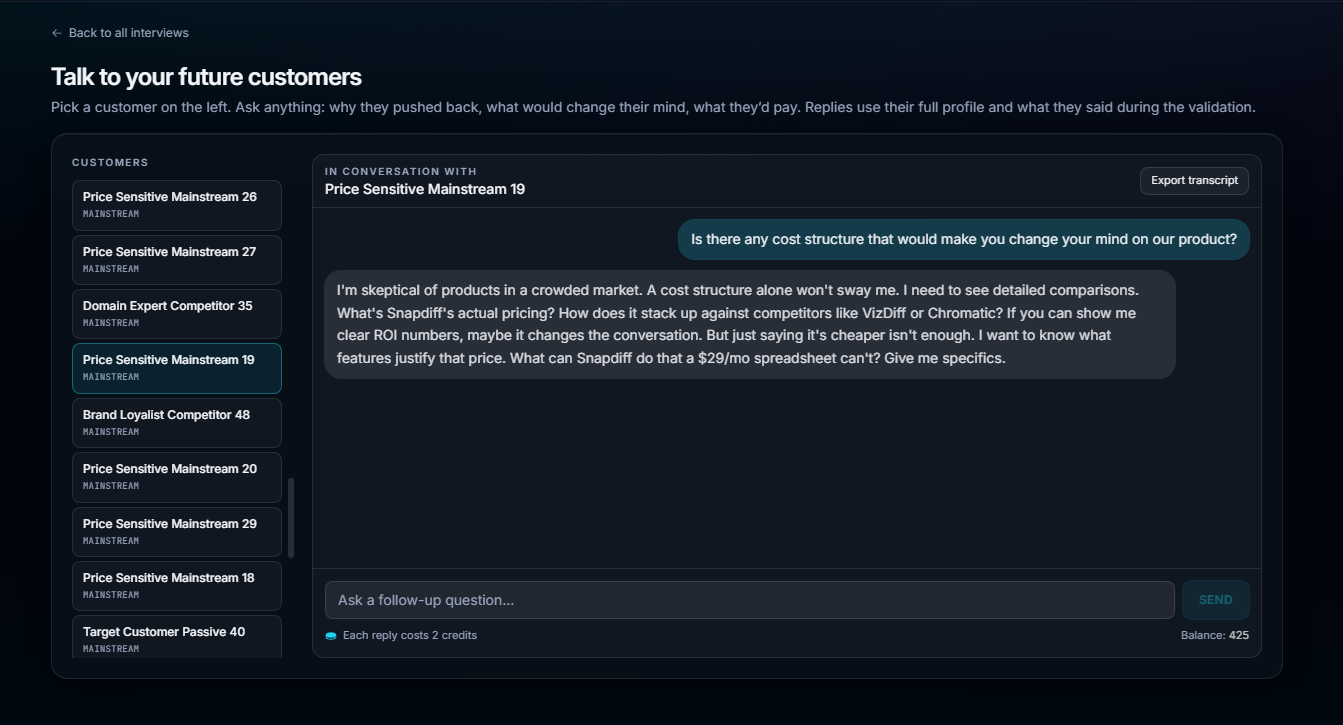 Interviewing a generated persona after the run — ask why they pushed back.
5. Test the what-ifs
Once you have a baseline, change one thing and re-run it. Drop the price. Narrow the audience. Reframe the pitch. Comparing the before and after tells you which levers actually move the response, so you iterate on the idea before you iterate on the product.
Validate before you build. Describe your idea, simulate the reactions, and walk away with ranked objections, an early-adopter archetype, and a confidence score you can show a co-founder. → Validate my idea
Don't stop at the simulation
The mistake is treating an AI validation as the finish line. It isn't. It's the fastest way to get to a good go, no-go, or pivot decision, and to know exactly what to ask when you do talk to real customers. Use it to kill weak ideas cheaply and to focus your energy on the ones worth the real work.
If you're earlier than this and don't have an idea to validate yet, start with how to start a business with AI, which walks the whole journey from finding an idea through launch.
Common questions
Can AI validate a business idea?
AI can give you a fast first read on an idea: likely objections, who would buy first, and where the idea is weak. It can't confirm real demand on its own, because only paying customers can do that. Treat it as a cheap way to find problems early and decide where to focus, not as a final verdict.
Is AI idea validation accurate? Can I trust it?
An AI validation is a prediction, not a guarantee. It's most trustworthy when it's grounded in real evidence, like actual customer quotes, rather than the model's imagination. Use it to surface objections and prioritize, then confirm the important ones with a handful of real customers before you bet on them.
How is AI validation different from a survey?
A survey asks people what they think they'd do, which is a weak predictor. AI validation simulates reactions and lets you probe them with follow-up questions, much faster than recruiting survey respondents, and you can re-run it as you change the idea, price, or audience.
Does AI validation replace talking to real customers?
No. It makes those conversations better. By the time you talk to a real customer, you already know the likely objections and the questions worth asking, so you don't waste your first few interviews figuring out where to dig.
Stop guessing whether anyone wants it.
Run AI-simulated customer reactions and walk away with archetypes, objections, and a confidence score — in minutes, not months.
200 free credits on signup. No card required.