
How to Start a Business With AI: A Step-by-Step Guide
AI can now do the slow, expensive parts of starting a business in minutes. Here's how to use it at each step, from finding an idea to landing your first customers.
By James Edgewood · Contributor at TheQuandary
There's a lot of noise around AI right now, and most of it is about the tools. A new one launches every week, each promising to do more than the last. The tools are the easy part. What actually decides whether any of this helps you build a business is the unglamorous work underneath it: knowing who you're selling to, finding out whether they'll pay, and keeping enough judgment to override a confident answer when it's wrong.
It's worth saying that plainly, because it's easy to mistake activity for progress. AI has genuinely changed the economics of starting a company. Research that took weeks takes an afternoon. A first version that used to cost months or a developer's salary you can now put together yourself. But the thing that kills most businesses hasn't changed at all: not enough people wanted what got built. AI makes you faster. It doesn't make you right. This guide walks the whole path and tries to be clear about which is which at each step.
Step 1: Find an idea (if you don't have one)
If you're stuck at the very start, AI is a decent brainstorming partner, with one big caveat. Ask a general model for "business ideas" and you'll get generic, crowded suggestions everyone else is also getting. The ideas worth pursuing are usually grounded in something specific to you: your skills, your industry, the problems you've watched go unsolved.
So the better prompt isn't "give me business ideas." It's "here's my background, my budget, and what I'd refuse to build; what problems am I unusually well placed to solve?" That framing produces candidates only you could credibly chase. There's a fuller walkthrough in finding a business idea from your résumé, more on the approach in AI business ideas, and, if you're skeptical it can work at all, can AI come up with a business idea?
This is also what TheQuandary's Reverse Mode does directly: you describe yourself, and it generates candidate businesses, runs a quick validation on each, and ranks them. The point isn't to hand you a winner, it's to get you to a short list worth testing instead of a blank page.
Step 2: Pressure-test the idea before you build
This is the step that saves you the most time and money, and the one people rush past. Before you build anything, you want evidence that real people have this problem and would pay to solve it.
AI changes the economics here. The classic advice is to interview 10 to 20 potential customers, which is right but slow, and early on you usually can't find that many willing to talk. AI lets you run a fast first pass: simulate how your target customers would react, surface the objections, and see where the idea is weak before you've spent a dollar building. The mechanics are in how to use AI to validate a business idea; the underlying principles, AI aside, are in validating a business idea before you build.
The output you want from this step is a clear read: who'd buy first, what they'll push back on, and whether the signal is strong enough to keep going. If it isn't, that's not a failure. It's months you just saved.
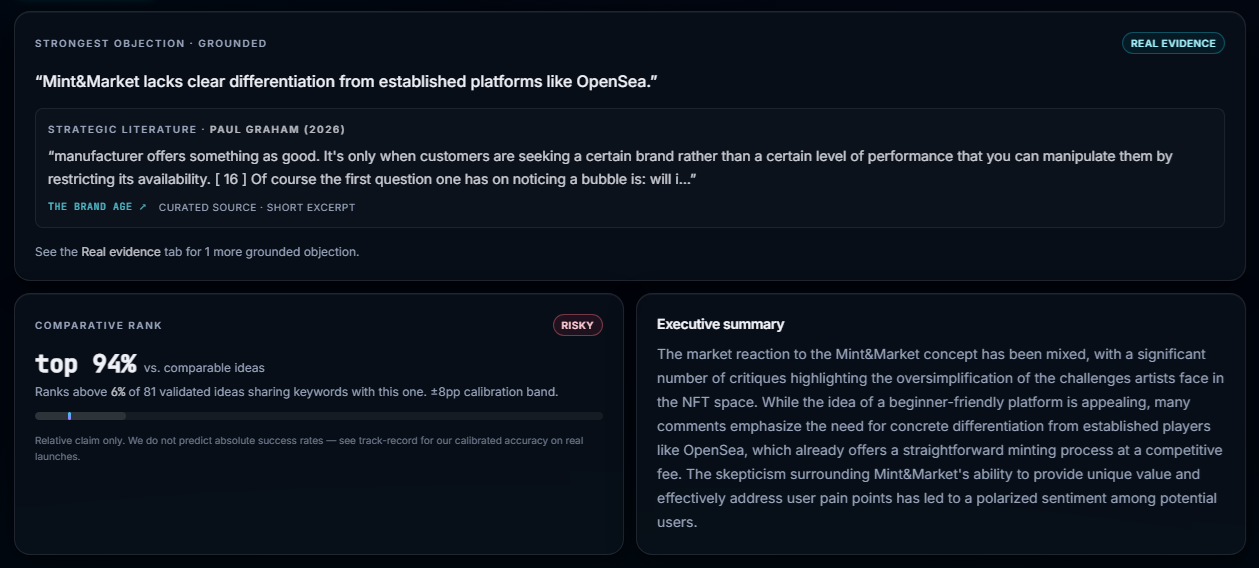 Ranked objections and a confidence score you can defend.
Hear the objections before you build. Run a simulation and you get customer archetypes, objections ranked and tied back to real public quotes, and a confidence score you can defend. → Find me an idea
Step 3: Understand the market and your customers
Once an idea clears the first pass, you need to understand the landscape: who already serves this market, what customers complain about, and how they talk about the problem.
AI is genuinely good here. It can summarize competitor reviews and map the landscape, pull out the recurring complaints in a niche, and draft customer personas you can sanity-check. The trick is to ground it in real sources rather than letting it invent. Reading what people actually say, in their own words, beats any summary written from imagination. TheQuandary leans on this by matching objections to real public posts and to startup literature, with links you can open and verify. (These AI personas are often called synthetic users, and they're a fast first pass, not a replacement for real ones.)
It also helps to talk to your customers, even before you have any. AI personas can stand in for the interviews you can't yet schedule, so you walk into the real conversations already knowing what to ask. More on that in interviewing your customers before you have any.
Step 4: Build the first version
Now you build, and this is where AI has changed the most. You can stand up a landing page, a simple app, or an automation with natural-language tools and no real budget. If you can describe what you want, you can usually get a rough working version, then refine it.
Two warnings. First, keep the first version small. The goal is something real enough to put in front of a customer, not a finished product. Second, AI-generated code and copy still need a human to check them; it's fast, not infallible. Build the smallest thing that tests your riskiest assumption, and resist the urge to polish before anyone has used it. (For a tool-by-tool rundown of what to use at each stage, see the best AI tools for founders.)
Step 5: Get your first customers
A product with no customers isn't a business yet. AI can help you write the landing copy, draft outreach, and produce content, but the early customers almost always come from conversations, not automation.
Use AI to remove the friction: turn the objections you found in Step 2 into landing-page copy in the customers' own words, draft the cold emails, summarize the calls. Then do the unscalable part yourself. Talk to people, watch them use the thing, and listen for the gap between what they say and what they do. That feedback is what turns a first version into something people actually pay for.
What AI is still bad at
It's worth being clear-eyed about the limits, because the failures tend to come from over-trusting the tools:
- Judgment and taste. AI can generate options; deciding which one is right is still on you.
- Real conversations. A simulated customer is a fast rehearsal, not a substitute for a real buyer's wallet.
- Originality of insight. The best ideas come from something you've seen that the model hasn't.
The pattern that works is to let AI compress the slow, repetitive work, the research, the drafts, the first passes, so you spend your time on the decisions and the conversations that only you can have.
The short version
Starting a business with AI doesn't mean handing the whole thing to a model. It means using AI to do in minutes what used to take weeks, finding candidates, pressure-testing them, researching the market, building a first version, so you reach the moment of truth (does anyone want this?) faster and cheaper than ever.
The one step not to skip is validation. If you do nothing else from this guide, test the idea against real customer reactions before you build. It's the cheapest insurance you'll buy.
Common questions
Can you really start a business with AI?
Yes, in the sense that AI can do most of the slow, expensive groundwork: generating ideas, research, first drafts, landing pages, even working prototypes. What it can't do is decide for you or talk to real customers on your behalf. Use it to compress the busywork, not to replace your judgment.
What's the best AI tool to start a business?
It depends on the stage. For finding and validating an idea, use a tool built for that, like TheQuandary. For building, general coding and design assistants work well. For marketing, writing and image tools. There's no single tool; you'll stack a few across the journey.
Do I need to know how to code to start a business with AI?
No. AI has lowered the bar a lot. You can build landing pages, simple apps, and automations with natural-language tools and no-code platforms. Knowing some basics still helps you go further, but it's no longer a hard requirement to get started.
Can AI replace market research?
It can speed it up dramatically, but not replace it entirely. AI is excellent at summarizing what people already say in public and at simulating likely reactions. You still want to confirm the important findings with a few real customers before betting on them.
Stop guessing whether anyone wants it.
Run AI-simulated customer reactions and walk away with archetypes, objections, and a confidence score — in minutes, not months.
200 free credits on signup. No card required.