
How to Do Market Research With AI (Without Fooling Yourself)
AI can do a credible first pass at market research in an afternoon. Here's how to use it for speed without trusting numbers it made up.
By James Edgewood · Contributor at TheQuandary
Market research used to mean weeks of surveys, analyst reports, and spreadsheets. AI compresses a lot of that into an afternoon. The risk is that the speed makes it easy to fool yourself, because a model will hand you a confident, well-formatted answer whether or not it's true. Used carefully, though, AI is one of the highest-leverage tools a founder has for understanding a market early.
Here's how to get the speed without the self-deception.
What market research is actually for
Before the tools, remember the point. Early market research should answer a few practical questions: who else serves this market, what customers are unhappy about, how big and reachable the opportunity is, and how people talk about the problem. You're not writing a report for a board. You're deciding whether and how to proceed.
Where AI genuinely helps
- Summarizing competitor reviews. Point it at the one- and two-star reviews of competitors and it'll cluster the complaints. That's a ready-made list of unmet needs.
- Mapping the landscape. Who the players are, roughly how they position, where the gaps seem to be.
- Finding where customers talk. The forums, subreddits, and communities where your customer already complains, so you can read the unfiltered version.
- Drafting personas you can sanity-check, and simulating reactions to your idea before you've talked to anyone.
The trap: confident, made-up facts
The single biggest mistake is trusting numbers a model produces. Ask a general AI for "the market size for X" and it will often give you a precise figure that's essentially invented. The same goes for growth rates, competitor revenue, and adoption stats.
The rule that keeps you honest: AI is for patterns and summaries, real sources are for facts. If a number is going to influence a decision, trace it to something you can verify. This is also why grounding matters when you research customers. Reading what people actually wrote beats any summary generated from imagination, which is the approach TheQuandary takes by matching findings to real public posts with links you can open.
A workable process
- Write down the question you're trying to answer. "Is this market crowded?" is researchable. "Is this a good idea?" is too vague.
- Gather real sources first: competitor reviews, forum threads, public discussion.
- Use AI to summarize and structure what you gathered, not to invent it.
- Simulate customer reactions to pressure-test the idea, then validate the important findings with AI and, eventually, real people.
- Confirm anything that matters with a handful of real customers. AI tells you where to dig; people tell you if you're right.
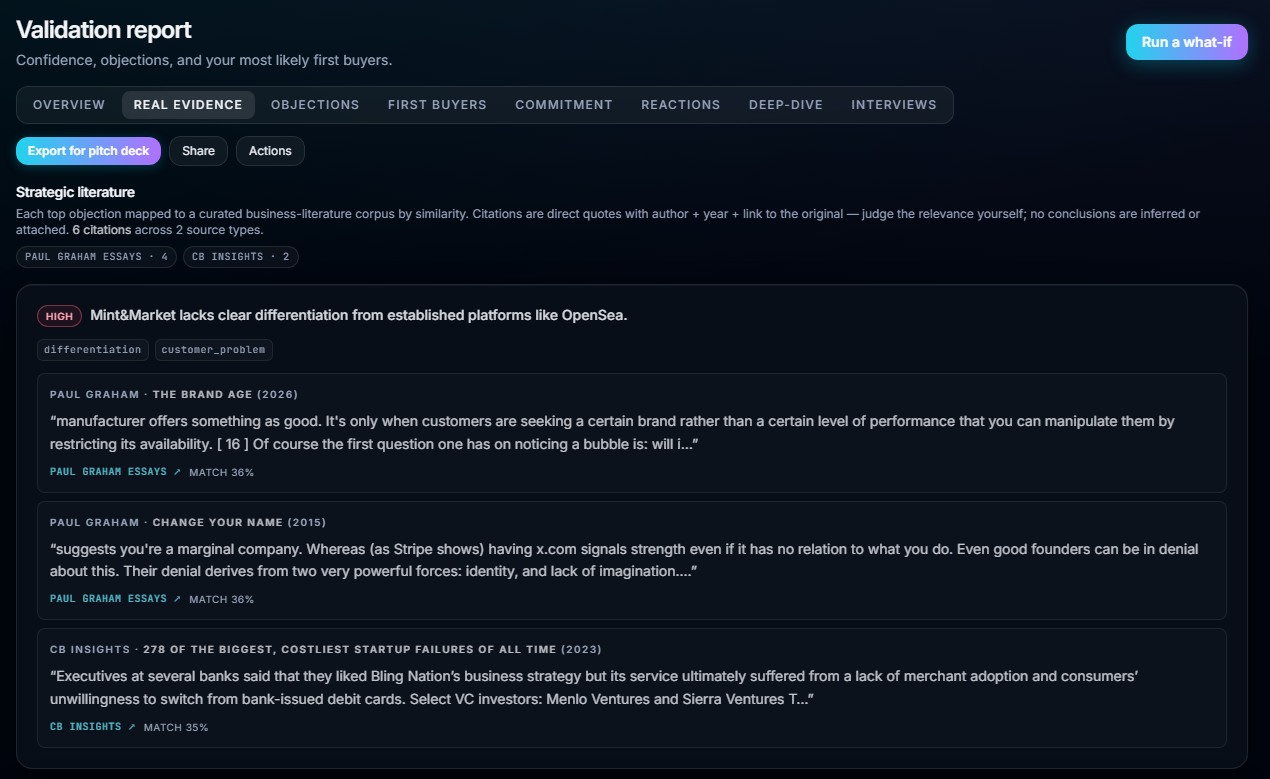 Findings matched back to real public posts, with links you can open and check.
Research your customers, grounded in real voices. TheQuandary surfaces the objections your market already voices in public, with sources, then lets you interview AI personas to dig deeper. → Validate my idea
Don't outsource the judgment
AI can gather and summarize faster than any human. What it can't do is decide what the findings mean for your specific situation, or notice the thing that isn't in the data. Use it to clear the busywork, then make the call yourself.
For the wider workflow this fits into, see how to start a business with AI. To go deeper on simulated research specifically, read about synthetic users.
Common questions
Can AI do market research?
AI can do a fast first pass: summarizing competitor reviews, mapping who serves a market, pulling out the recurring complaints in a niche, and simulating likely customer reactions. It can't reliably produce hard numbers like market size or growth rates on its own, so treat those as starting points to verify, not facts.
Is AI market research reliable?
It's reliable for direction and unreliable for specifics. AI is good at patterns and summaries but will confidently state made-up statistics. Anything that matters to a decision, especially numbers, should be grounded in a real source you can check.
What AI tools are best for market research?
General assistants are good for summarizing and structuring research. For understanding customers specifically, tools that ground their output in real public discussion or simulate customer reactions, like TheQuandary, are more useful than a model working from imagination.
Does AI market research replace talking to customers?
No. It tells you where to look and what to ask, which makes your real conversations far more efficient. But the decisions that matter still need confirmation from real people who might actually pay.
Stop guessing whether anyone wants it.
Run AI-simulated customer reactions and walk away with archetypes, objections, and a confidence score — in minutes, not months.
200 free credits on signup. No card required.