
Synthetic Users: Using AI for Customer Research
Synthetic users are AI personas that stand in for real customers in research. Here's what they're genuinely good for, where they mislead, and how to use them responsibly.
By James Edgewood · Contributor at TheQuandary
"Synthetic users" is the term for AI personas that stand in for real customers during research. Instead of recruiting people to interview or survey, you generate personas and study how they react. The idea has caught on for a simple reason: real research is slow and expensive, and synthetic users are neither. The catch is that a simulation is still a simulation, and treating it as truth is how teams get misled.
This post covers what synthetic users are good for, where they go wrong, and how to use them without fooling yourself.
Why they exist
Traditional customer research has a cost problem, especially early. Recruiting the right participants takes time and money, and before you've launched anything you often can't find them at all. Synthetic users fill that gap. They give you something to react against in minutes, which is genuinely valuable when the alternative is building blind.
What they're good for
- Surfacing objections early. Before you talk to a real customer, synthetic users can show you the likely pushback, so you're not discovering it on a live call.
- Rehearsing interviews. They let you practice the conversation and refine your questions, which makes your real customer interviews far more productive.
- Fast iteration. You can change the idea, the price, or the audience and re-run instantly, which no panel of real people will let you do.
Where they mislead
Three failure modes are worth knowing:
- They agree too easily. Models tend toward agreeableness, so an ungrounded synthetic user can give you false encouragement. Enthusiasm from a simulation is not demand.
- They inherit the model's biases. A synthetic user only knows what the model knows, which skews toward the average and away from the specific person you're targeting.
- They can invent. Without grounding, the reactions are plausible fiction rather than evidence.
The common thread: a synthetic user is only as trustworthy as what it's grounded in.
How to use them responsibly
The teams that get value from synthetic users follow a few rules. Ground them in real data rather than pure imagination. Use them for direction and objection-finding, not as proof of demand. And confirm anything that drives a real decision with actual users.
This is the approach TheQuandary takes: the personas react, but the objections are matched back to real public posts from places like Reddit and Hacker News, with links, so you're seeing patterns from real voices rather than a model's guess. You can then interview the personas to dig in, and use what you learn to sharpen your real conversations. It's the same principle behind doing market research with AI: fast simulation up front, real confirmation before you bet.
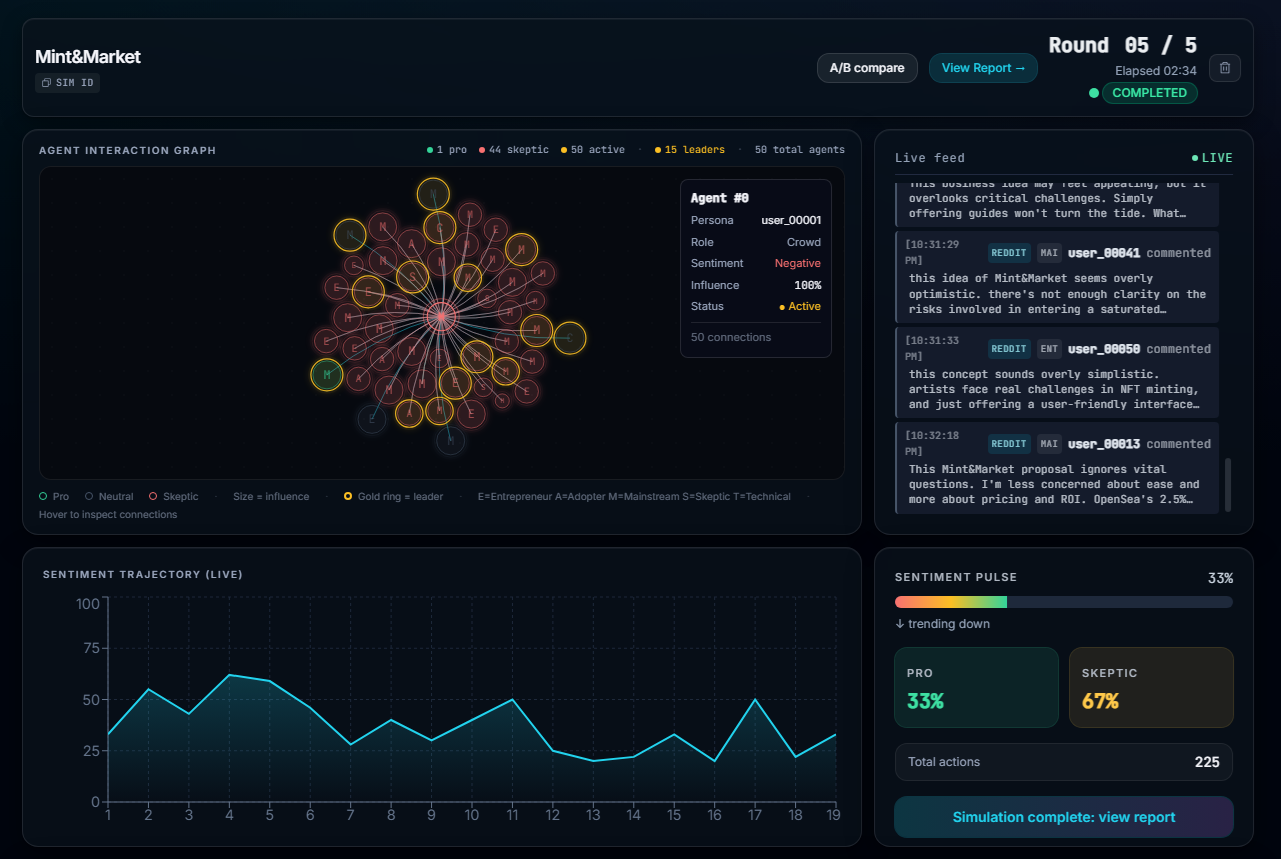 Simulated customers reacting to the idea in real time.
Synthetic users, grounded in real voices. Simulate customer reactions, see objections tied to real public quotes, and interview the personas afterward, then take what you learn into real conversations. → Validate my idea
The bottom line
Synthetic users are a powerful first pass and a poor final answer. Use them to move fast, find the objections, and rehearse, then let real customers tell you whether you're right. For where this fits in the broader workflow, see how to validate a business idea with AI and how to start a business with AI.
Common questions
What are synthetic users?
Synthetic users are AI-generated personas that simulate how real customers might react to an idea, a product, or a question. They're used to get fast, cheap research signal when recruiting real participants is slow or expensive, especially very early when you don't have customers yet.
Are synthetic users accurate?
They're directionally useful, not authoritative. Synthetic users are good at surfacing likely objections and reactions, but they can agree too easily and reflect the biases of the underlying model. They're most trustworthy when grounded in real data rather than pure imagination, and they should be confirmed with real people before big decisions.
Can synthetic users replace real user research?
No. They're a complement and a rehearsal, not a replacement. Use them to move fast, find objections, and sharpen your questions, then validate what matters with real users who might actually pay or churn.
How are synthetic users different from a focus group?
A focus group is real people in real time, which is slower, costlier, and harder to arrange but carries real-world weight. Synthetic users are instant and cheap and let you re-run scenarios endlessly, at the cost of being a simulation. Many teams use synthetic users to prepare for, not replace, real sessions.
Stop guessing whether anyone wants it.
Run AI-simulated customer reactions and walk away with archetypes, objections, and a confidence score — in minutes, not months.
200 free credits on signup. No card required.